
CELEBRITY
📰 BREAKING NEWS — Obama calls U.S. political discourse a “clown show” after Trump shares racist monkey video — Former President Barack Obama criticized the erosion of decorum in U.S. politics and described recent political behavior — sparked by a controversial AI‑generated video shared on Donald Trump’s social media that depicted Obama and Michelle Obama as apes — as a “clown show,” saying many Americans find such conduct “deeply troubling.”

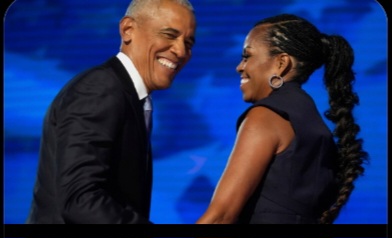
📰 BREAKING NEWS — Obama Slams Political Discourse as “Clown Show” After Trump Shares Racist Video Depicting Him and Michelle Obama as Apes
Former U.S. President Barack Obama has publicly condemned the erosion of political decorum and respect in American public life, describing recent political behavior — especially the sharing of an offensive AI‑generated video — as a “clown show” in social media and national discourse. Obama’s remarks come amid widespread controversy after the short, racially insensitive clip was briefly posted on Donald Trump’s Truth Social account earlier this month.
The video in question featured brief imagery that placed the heads of Obama and former First Lady Michelle Obama onto the bodies of apes — a deeply offensive trope rooted in historical racist caricatures that have been widely condemned by civil rights groups and political leaders. The White House later said the clip was posted in error by a staffer and removed from the platform after significant public backlash.
Speaking on a podcast hosted by political commentator Brian Tyler Cohen, Obama addressed the controversy indirectly; he did not mention Trump by name but made clear his disapproval of the behavior that allowed such content to be amplified on major public platforms. “There’s this sort of clown show that’s happening in social media and on television,” Obama said, reflecting frustration with how modern political communication has often shifted toward outrage, sensationalism, and a lack of accountability.
Obama’s comments marked the first time he has spoken at length about the incident, which occurred during Black History Month — a period typically dedicated to honoring the achievements and history of African Americans. The timing of the video’s release added fuel to the fire, drawing criticism not just from Democrats but also from civil rights organizations and some Republicans who called the imagery “incredibly offensive” and urged leaders to take a firm stand against racism in political messaging.
During the podcast interview, Obama lamented how political discussions have deteriorated, saying that basic standards of decorum, propriety, and respect once expected from public officials and media figures have been eroded. He noted that while many Americans still value civility and kindness, the current climate too often rewards shocking and dehumanizing content that distracts from substantive policy debates and governance.
“There doesn’t seem to be any shame about this anymore,” Obama said, emphasizing that in earlier decades, public leaders — regardless of party — generally understood the importance of maintaining a certain level of respect even in heated political debates. He added that such behavior is concerning and contributes to increased polarization, making constructive dialogue and governance more difficult.
The former president also suggested that the backlash to the racist video could have political ramifications. He said that a majority of Americans find such behavior “deeply troubling,” and warned that normalizing derogatory or dehumanizing content may hurt the political fortunes of those associated with it, particularly in the upcoming midterm elections this year.
Reaction to Obama’s remarks has been mixed across the political spectrum. Some commentators praised him for addressing the issue with measured language and emphasizing the importance of upholding democratic and civil norms, while others accused him of engaging in partisan criticism. Still others pointed to the broader context of rising political polarization and the role of social media in amplifying provocative and offensive material.
Civil rights leaders and advocacy groups have also weighed in on the controversy. Many have condemned the original video as harmful and dehumanizing, particularly because of its use of racist imagery that historically has been used to demean Black people. These leaders argue that such content has no place in political discourse and that public officials should be held accountable for what they share or endorse on influential platforms.
At the same time, some conservative commentators and supporters defended Trump’s actions by calling the original video satire or saying that the backlash represented an overreaction from critics. These differing interpretations highlight the starkly divided nature of American political culture, in which even offensive content can be interpreted through widely disparate lenses.
The incident and Obama’s response underscore ongoing concerns about the role of technology and AI in shaping public perception and political messaging. The ease with which AI‑generated content can be created and distributed — sometimes without clear context or accurate attribution — has raised questions about the need for stronger content moderation standards, digital literacy efforts, and ethical guidelines for public communication.
As public debate around the issue continues, Obama’s call for increased civility and refusal to normalize dehumanizing behavior mark a clear attempt to steer political discourse toward identifying shared values rather than amplifying division. “Most Americans still believe in decency, courtesy, and kindness,” he said, urging citizens and leaders alike to recommit to those principles even in the face of escalating .

📰 BREAKING NEWS — Taylor Swift’s Chart Rivalry with Former Flame Sparks Frenzy Amid Romance with Travis Kelce — Pop superstar Taylor Swift finds herself at the center of a media and fan frenzy as her music charts collide with those of a former partner, all while her high-profile romance with NFL star Travis Kelce captures public attention, highlighting both her enduring influence in music and her evolving personal life.

📰 BREAKING NEWS — “I Get to Marry This Person”: Taylor Swift Opens Up on Evolving Views on Marriage — Pop superstar Taylor Swift has shared insights into her changing perspective on love and marriage, reflecting on her real-life relationship with fiancé Travis Kelce and expressing excitement about building a future together, signaling a new chapter in her personal life.

📰 BREAKING NEWS — Taylor Swift Bags Best‑Selling Artist of 2025 Award — Taylor Swift has officially been named the best-selling artist of 2025, cementing her dominance in global music sales and marking another milestone in her record-breaking career, with outstanding performance across streaming, digital, and physical album formats.

📰 BREAKING NEWS — Taylor Swift Named Best‑Selling Global Artist for Historic Sixth Time — Taylor Swift has been officially recognized by the International Federation of the Phonographic Industry (IFPI) as the top-selling global artist of 2025, marking a record-breaking sixth time she has earned this distinction and solidifying her status as one of the most commercially successful artists in music history.

📰 BREAKING NEWS — Obama calls U.S. political discourse a “clown show” after Trump shares racist monkey video — Former President Barack Obama criticized the erosion of decorum in U.S. politics and described recent political behavior — sparked by a controversial AI‑generated video shared on Donald Trump’s social media that depicted Obama and Michelle Obama as apes — as a “clown show,” saying many Americans find such conduct “deeply troubling.”

📰 BREAKING NEWS — U.S. Secret Service kills armed man who breached Trump’s Mar‑a‑Lago security perimeter — Secret Service agents and a sheriff’s deputy shot and killed an armed individual after he entered the secure perimeter of President Donald Trump’s Mar‑a‑Lago resort in Palm Beach, Florida; the president was in Washington, D.C. at the time.

BREAKING NEWS: Ukrainian President Volodymyr Zelensky has declared that Russian President Vladimir Putin has already started “World War III,” warning the conflict could expand further if Moscow’s aggression isn’t stopped and urging international support as Russia’s invasion of Ukraine nears its fourth anniversary amid ongoing battles, deep political tensions, and stalled peace efforts.

BREAKING NEWS: Donald Trump announces sweeping new global tariffs, triggering sharp market reactions, diplomatic tension, and intense debate across Europe, Asia, and Africa, as governments, businesses, and consumers warn of rising prices, trade retaliation, economic uncertainty, and potential long-term disruption to global supply chains, jobs, growth, stability, and alliances worldwide.

“Anthony Joshua’s Worst Nightmare: Dubois Unleashes Brutal Knockout at Wembley Stadium!”…Watch the fight that ended Joshua’s title hopes and sent shockwaves through the boxing world!…

⚡️ “Supreme Court Just Gave Trump a Wild Card on Federal Agencies—Your Vote Could Be Next!” The high court is hearing arguments that could let the president fire FTC commissioners without cause. Dive into the details and share your take—will this reshape the balance of power?

⚡️ “$12 Billion for America’s Farmers? Trump’s Shocking Hand‑out Will Change Your Feed!” The president just rolled out a massive $12 billion aid package for struggling farmers—right before the midterms. Click to see the full list of who wins and who’s already calling it “political bribery.”
