
NEWS
BREAKING NEWS — **Donald Trump calls for regime change in Iran as the United States and Israel unleash massive, coordinated strikes, triggering global alarm, Middle East airspace shutdowns, and fears of a wider regional war with worldwide economic consequences.

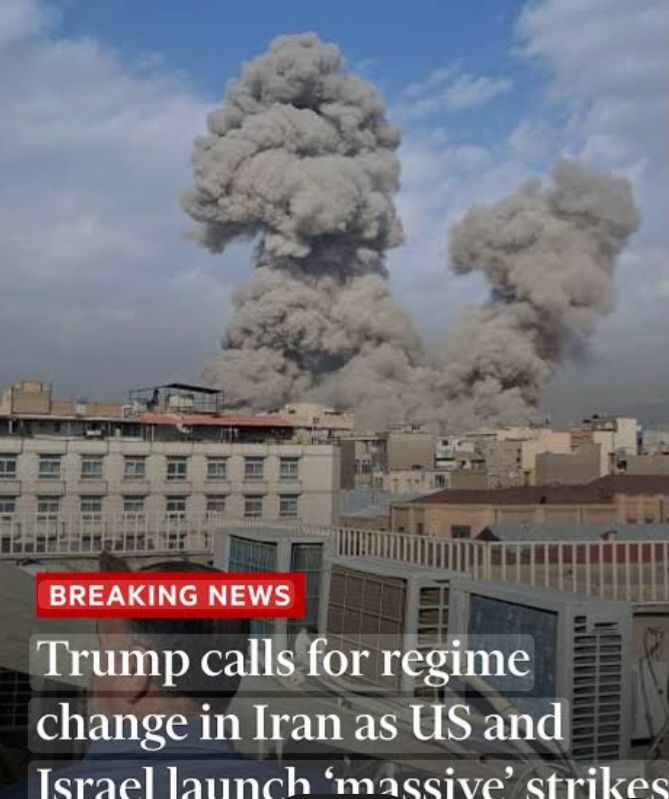
The world awoke to a dramatic escalation in Middle East tensions as Donald Trump publicly called for regime change in Iran following what U.S. officials described as “massive and ongoing” military strikes carried out jointly by the United States and Israel. The coordinated operation marks one of the most serious confrontations between Washington and Tehran in decades, sending shockwaves through global politics, energy markets, and diplomatic circles.
According to U.S. and Israeli sources, the strikes targeted key Iranian military infrastructure, including air defense systems, missile facilities, and command-and-control sites. Explosions were reported in and around major urban and strategic locations, including Tehran, as air raid sirens echoed across parts of the region. Iranian state media acknowledged the attacks, describing them as a “blatant act of aggression,” while promising a response “at a time and place of Iran’s choosing.”
In a televised address and a series of social media posts, President Trump confirmed the operation and framed it as a decisive move to neutralize what he called “imminent and growing threats” from Iran’s government. He went further than previous U.S. statements by openly urging the Iranian people to rise up against their leaders, arguing that the current leadership had brought economic hardship and international isolation upon the country. “The future of Iran belongs to its people,” Trump said, signaling that regime change was now an explicit political goal rather than a byproduct of military pressure.
Israeli officials echoed the urgency of the operation, stating that the strikes were necessary to prevent Iran from expanding its missile capabilities and regional influence. Israel has long accused Iran of backing armed groups hostile to Israeli security, and leaders in Jerusalem described the joint action as a matter of national survival. Defense officials emphasized that coordination with the United States was close and continuous, underscoring the depth of the alliance at a critical moment.
Iran’s response was swift in rhetoric and measured but tense on the ground. Senior Iranian leaders condemned the strikes and accused Washington and Jerusalem of violating international law. While full details of Iran’s military reaction remain unclear, reports indicated heightened alert levels across Iranian forces and allied groups in the region. Analysts warned that even limited retaliation could quickly spiral into a broader conflict involving multiple countries.
The immediate regional impact was severe. Several Middle Eastern states moved to temporarily close or restrict their airspace as a precaution, disrupting international travel and trade routes. Concerns also mounted over shipping through the Strait of Hormuz, a vital corridor for global oil supplies. Energy markets reacted nervously, with oil prices jumping amid fears of supply disruptions if the conflict expands.
International reactions poured in within hours. Russia and China criticized the strikes, calling for restraint and warning that further escalation could destabilize the entire region. European leaders urged an immediate return to diplomacy, expressing concern over civilian safety and the risk of a prolonged war. At the United Nations, emergency consultations were requested as diplomats scrambled to assess the rapidly changing situation.
In the United States, the strikes triggered intense political debate. Supporters of the administration argued that decisive action was necessary after years of failed negotiations and mounting tensions. Critics, however, questioned the legal basis and long-term strategy behind the operation, warning that calls for regime change could entangle the U.S. in another extended conflict in the Middle East. Members of Congress from both parties demanded briefings and clarity on the scope and objectives of the mission.
For ordinary Iranians, the moment is filled with uncertainty. Years of sanctions, economic strain, and political pressure have already taken a heavy toll, and the prospect of wider conflict raises fears about daily life, safety, and the country’s future. Humanitarian organizations have urged all sides to prioritize civilian protection and avoid actions that could worsen the humanitarian situation.
As the situation continues to evolve, the stakes could hardly be higher. What began as targeted military strikes has quickly become a defining geopolitical crisis, with implications far beyond the Middle East. Whether this moment leads to renewed diplomacy, prolonged confrontation, or a fundamental shift in Iran’s political landscape remains unclear. For now, the world watches closely as events unfold hour by hour, aware that decisions made in the coming days could reshape global security for years to come.

BREAKING NEWS: Viral reports claim an Israeli airstrike killed 40 Iranian elementary school students in Hormozgan, sparking global outrage, grief, and heated social media debates—though officials have yet to confirm the tragic incident, leaving facts still unverified.

BREAKING NEWS: Iran hits back across the Gulf, targeting Arab states hosting U.S. bases, rattling cities, shutting airspace, sparking interceptions, global alarm, memes, and midnight sirens as a regional crisis explodes faster than diplomacy can blink on a tense Friday

BREAKING NEWS: Smoke Over Al Wakrah as Iran Missiles Are Intercepted Near United States military Bases—Gulf Tensions Explode Into the Open

Am i beauty, they said am not :Serena Williams questions her own beauty

BREAKING NEWS: Travis Kelce Poised to Become the Next Voice of Thursday Night Football as Prime Video Eyes Star NFL Tight End for Big Broadcast Switch

BREAKING NEWS: Serena Williams Shocks the World With an Unseen On-Court Moment That Instantly Goes Viral, Leaving Fans and Celebrities Speechless

BREAKING NEWS: Serena Williams Leaves Fans Worldwide in Shock After a Jaw-Dropping On-Court Moment That No One Expected, Turning a High-Stakes Match Into a Viral Scene That Sparked Instant Reactions, Debates, and Global Conversation Across Sports and Social Media Platforms

BREAKING NEWS — **Donald Trump calls for regime change in Iran as the United States and Israel unleash massive, coordinated strikes, triggering global alarm, Middle East airspace shutdowns, and fears of a wider regional war with worldwide economic consequences.

BREAKING NEWS: Internet Erupts Over Stunning Beach Photo — Fans Left Gasping as Raw, Unfiltered Confidence Challenges Every Idea of Beauty, Strength, and Power, Sending Social Media Into a Frenzy Worldwide.

BREAKING NEWS: Jaw-Dropping Beach Photo Stuns the Internet — Raw, Unfiltered Confidence Takes Over Social Media, Leaving Fans Shocked as Beauty Standards Are Boldly Challenged With Zero Apologies.

BREAKING NEWS: Taylor Swift and Travis Kelce Set the Internet on Fire as Wedding Bells Rumored for June 13, 2026, Fueling Global Frenzy, Fan Theories, and Buzz Over a Fairytale Celebrity Celebration
