
CELEBRITY
BREAKING NEWS: Donald Trump falsely claims that Democratic voters receive “seven ballots” in an effort to push for stricter mail‑in voting restrictions. Election experts and critics denounce the statement as misleading, warning it fuels misinformation and undermines public trust in the electoral process nationwide.

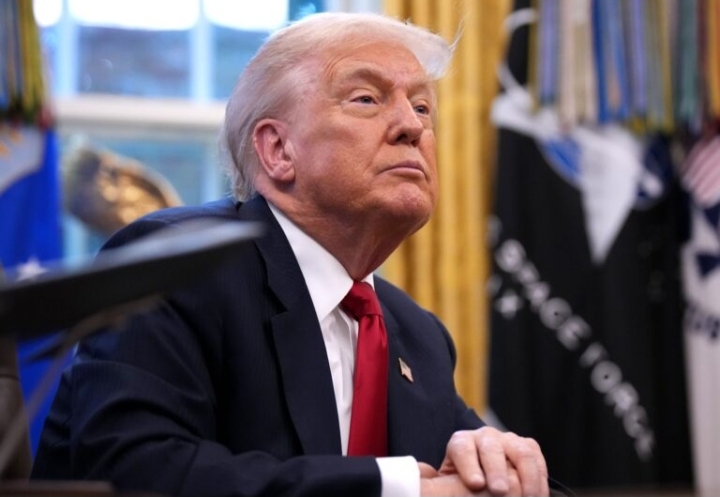
BREAKING NEWS: Donald Trump Falsely Claims Democrats Receive ‘Seven Ballots’ While Pushing for Mail‑In Voting Restrictions
President Donald Trump has sparked renewed controversy over voting practices by falsely claiming that Democratic voters receive “seven ballots” in elections, a statement critics and election experts say is entirely unsubstantiated. The claim was made in the context of a broader push by the Trump administration and Republican allies to restrict mail-in voting across several states, citing concerns over voter fraud despite overwhelming evidence that such fraud is extremely rare.
During a recent rally and in several media appearances, Trump reiterated that Democratic voters exploit mail-in ballots to cast multiple votes, asserting that this purported practice threatens the integrity of American elections. Experts quickly denounced the remarks, describing them as a baseless falsehood designed to promote a political agenda rather than reflect factual evidence. According to multiple independent studies, including reports from the Brennan Center for Justice and state election officials, instances of widespread mail-in voter fraud are virtually nonexistent, and claims of multiple ballots being cast by single voters have no documented basis.
Election integrity and voting rights advocates warn that Trump’s statement risks undermining public confidence in the democratic process. By promoting misinformation, critics argue, such claims could discourage eligible voters from participating in elections, create confusion about voting procedures, and inflame partisan divisions in an already polarized political climate. Legal scholars also note that spreading false narratives about election fraud could complicate efforts to implement fair and secure voting procedures nationwide.
Trump’s push to restrict mail-in voting is part of a larger political strategy that has been central to his platform. Republican officials in several states have sought legislation limiting absentee ballots, tightening identification requirements, and shortening early voting periods. Trump has consistently framed these measures as necessary to prevent voter fraud, even though federal and state investigations repeatedly confirm that American elections are highly secure and that voter fraud is exceedingly rare.
The timing of Trump’s latest remarks coincides with ongoing debates over voting access, particularly in states with large Democratic electorates. Many Democrats view the push for stricter mail-in voting laws as a politically motivated attempt to suppress turnout among groups that tend to support their party, including younger voters, minority populations, and urban residents. Election law experts argue that such measures could disproportionately affect vulnerable populations, creating significant barriers to participation in the electoral process.
Public reactions to Trump’s “seven ballots” claim have been sharply divided along partisan lines. Supporters of the president largely defend his statements, arguing that they highlight genuine concerns about election security and that measures to restrict mail-in voting are necessary to prevent irregularities. Critics, however, emphasize that promoting unfounded claims erodes trust in democratic institutions, risks legal challenges, and distracts from legitimate discussions about how to improve electoral transparency and accessibility.
Media coverage of the controversy has been extensive, with national and international outlets reporting on both the claim itself and the broader context of voting rights debates in the United States. Political analysts note that while Trump’s statements energize his base and reinforce his narrative about election fraud, they simultaneously galvanize opposition and deepen divisions in public opinion about the legitimacy of the voting process. The continuing spread of misinformation, amplified through social media platforms, further complicates efforts by election officials to provide clear and accurate information to voters.
The Trump administration’s emphasis on mail-in voting restrictions comes alongside ongoing legal and legislative battles. Multiple lawsuits challenging restrictive voting measures are currently pending in courts, and election officials in several states are actively defending the security and accessibility of absentee and mail-in ballots. Federal agencies have also conducted extensive audits and investigations, consistently confirming that mail-in voting is safe, secure, and an essential tool for maintaining participation, especially for voters who cannot access in-person polling places.
International observers have expressed concern about the impact of these statements on perceptions of American democracy. The United States has long been seen as a global standard for electoral integrity, but the promotion of false narratives about voter fraud risks undermining that reputation. Diplomatic analysts note that misinformation surrounding elections can have lasting consequences, both domestically and in terms of the U.S.’s role as a model for democratic governance abroad.
Despite widespread criticism, Trump shows no indication of retracting his statement, continuing to use the issue as a rallying point for political events and public appearances. Republican lawmakers supporting these measures argue that reforms are necessary to ensure election security, while Democratic leaders and voting rights advocates argue that the real threat is not voter fraud but the intentional restriction of access to ballots for eligible citizens.
In conclusion, President Donald Trump’s claim that Democratic voters receive “seven ballots” has reignited national debates over mail-in voting, election integrity, and the spread of misinformation in the United States. Experts emphasize that the claim is false, yet its political implications are significant, fueling partisan divisions and influencing legislative and judicial efforts surrounding voting access. As the country approaches upcoming elections, the controversy underscores the challenges of balancing security, accessibility, and public confidence in the democratic process. The Trump administration’s continued push for mail-in voting restrictions, combined with high-profile statements promoting unfounded claims, will remain a focal point of political discussion, media coverage, and public scrutiny in the months ahead, shaping both voter perception and broader national discourse about the future of American elections.

BREAKING NEWS: Donald Trump falsely claims that Democratic voters receive “seven ballots” in an effort to push for stricter mail‑in voting restrictions. Election experts and critics denounce the statement as misleading, warning it fuels misinformation and undermines public trust in the electoral process nationwide.

BREAKING NEWS: Donald Trump is prioritizing diplomacy as his first approach toward Iran, according to the White House, while maintaining military options as a contingency. Officials say the administration seeks negotiation and de-escalation, even as regional tensions remain high and international scrutiny intensifies over U.S. policy.

BREAKING NEWS: Donald Trump is increasingly viewed by most Americans as growing more erratic with age, according to a new national poll, highlighting rising concerns about leadership style, decision-making, and stability as political divisions deepen and debates intensify over his fitness to govern.

BREAKING NEWS: Donald Trump is set to deliver the first State of the Union address of his second term, outlining priorities on the economy, immigration, and foreign policy, as a divided Congress and nation watch closely for signals shaping governance, unity, and political battles ahead this year and global reactions.

BREAKING NEWS: Donald Trump to deliver his State of the Union address tonight as the United States remains deeply polarized, with sharp divisions over the economy, immigration, democracy, and foreign policy, as lawmakers, allies, critics, and global partners closely watch for signals shaping America’s political direction ahead of upcoming elections

📰 BREAKING NEWS — Taylor Swift’s Chart Rivalry with Former Flame Sparks Frenzy Amid Romance with Travis Kelce — Pop superstar Taylor Swift finds herself at the center of a media and fan frenzy as her music charts collide with those of a former partner, all while her high-profile romance with NFL star Travis Kelce captures public attention, highlighting both her enduring influence in music and her evolving personal life.

📰 BREAKING NEWS — “I Get to Marry This Person”: Taylor Swift Opens Up on Evolving Views on Marriage — Pop superstar Taylor Swift has shared insights into her changing perspective on love and marriage, reflecting on her real-life relationship with fiancé Travis Kelce and expressing excitement about building a future together, signaling a new chapter in her personal life.

📰 BREAKING NEWS — Taylor Swift Bags Best‑Selling Artist of 2025 Award — Taylor Swift has officially been named the best-selling artist of 2025, cementing her dominance in global music sales and marking another milestone in her record-breaking career, with outstanding performance across streaming, digital, and physical album formats.

📰 BREAKING NEWS — Taylor Swift Named Best‑Selling Global Artist for Historic Sixth Time — Taylor Swift has been officially recognized by the International Federation of the Phonographic Industry (IFPI) as the top-selling global artist of 2025, marking a record-breaking sixth time she has earned this distinction and solidifying her status as one of the most commercially successful artists in music history.

📰 BREAKING NEWS — Obama calls U.S. political discourse a “clown show” after Trump shares racist monkey video — Former President Barack Obama criticized the erosion of decorum in U.S. politics and described recent political behavior — sparked by a controversial AI‑generated video shared on Donald Trump’s social media that depicted Obama and Michelle Obama as apes — as a “clown show,” saying many Americans find such conduct “deeply troubling.”

📰 BREAKING NEWS — U.S. Secret Service kills armed man who breached Trump’s Mar‑a‑Lago security perimeter — Secret Service agents and a sheriff’s deputy shot and killed an armed individual after he entered the secure perimeter of President Donald Trump’s Mar‑a‑Lago resort in Palm Beach, Florida; the president was in Washington, D.C. at the time.
